
Special Purpose Acquisition Companies (SPACs) and Overseas Listings: Navigating India’s Evolving Regulatory Landscape

Introduction: The SPAC Wave and India’s Cautious Response
The past five years have witnessed a dramatic shift in how Indian startups access global capital markets. Traditional Initial Public Offerings (IPOs), once the gold standard for going public, now compete with an increasingly attractive alternative: Special Purpose Acquisition Companies (SPACs) and direct overseas listings on premier exchanges like the New York Stock Exchange (NYSE) and NASDAQ.
Between 2020 and 2023, over 600 SPACs raised more than $160 billion globally, with Indian-origin companies such as ReNew Power, Grab (founded by an Indian entrepreneur), and Oyo exploring or completing SPAC mergers. Yet despite this global enthusiasm, India remains conspicuously absent from the SPAC party. The Securities and Exchange Board of India (SEBI) issued a consultation paper in 2024 seeking public comments on introducing a domestic SPAC framework—but no final regulations have emerged.
This article examines why Indian startups are increasingly pursuing overseas listings, the regulatory complexities they face under India’s Foreign Exchange Management Act (FEMA) and tax laws, and why SEBI has hesitated to greenlight SPACs on Indian soil.
Understanding SPACs: The “Blank Check Company” Phenomenon
A SPAC is a shell company with no commercial operations, formed solely to raise capital through an IPO for the purpose of acquiring an existing private company. The transaction effectively takes the target company public without the lengthy, expensive process of a traditional IPO.

Why Startups Prefer SPACs Over Traditional IPOs
|
Traditional IPO |
SPAC Merger |
| 12–18 month timeline | 3–6 month timeline |
| Extensive roadshows required | Negotiated valuation with sponsor |
| Market volatility risk at listing | Price certainty at announcement |
| Higher underwriting fees (5–7%) | Lower transaction costs (3–5%) |
| Regulatory scrutiny of projections | Forward-looking statements permitted |
The appeal is obvious: speed, certainty, and flexibility. For cash-hungry startups in capital-intensive sectors like electric vehicles, renewable energy, and fintech, SPACs offered a lifeline during uncertain market conditions.
The Indian Startup Exodus: Why Overseas Listings Matter
As of early 2025, over 15 major Indian startups have either completed or are pursuing overseas listings, including:
- ReNew Power (NASDAQ via SPAC, 2021)
- Pine Labs (considering US IPO)
- Flipkart (NYSE listing anticipated)
- Oyo (explored SPAC route in 2022–2023)
The reasons for this migration are structural:
- Valuation Premium: US markets historically assign higher multiples to technology companies than Indian bourses.
- Deeper Capital Pools: Access to institutional investors with higher risk appetites for growth-stage companies.
- Global Credibility: A NYSE or NASDAQ listing signals maturity and attracts top-tier talent and clients.
- Regulatory Flexibility: Disclosure norms in the US permit forward-looking statements, critical for startups to articulate growth narratives.
Regulatory Framework I: RBI’s ODI Rules and FEMA Compliance
Any Indian company seeking an overseas listing must navigate the Reserve Bank of India’s Overseas Direct Investment (ODI) framework under the Foreign Exchange Management Act, 1999.
Key FEMA Requirements
Step 1: Overseas Direct Investment Approval Under the Overseas Investment Rules, 2022, an Indian entity can establish or acquire a foreign entity (such as a holding company in Delaware, USA or Singapore) for the purpose of listing overseas. The investment is treated as ODI and subject to:
- Automatic Route: Permitted up to 400% of the Indian entity’s net worth without prior RBI approval
- Pricing Guidelines: Valuation must be determined by a SEBI-registered Category I Merchant Banker or an independent chartered accountant
- Reporting Obligations: Form ODI (within 30 days) and Annual Performance Reports (APR) filed via the Single Master Form (SMF)
Step 2: Flip Structure Most Indian startups undertake a “flip”—restructuring ownership so that a foreign parent company (typically incorporated in Delaware or Singapore) becomes the holding company, with the Indian entity as a subsidiary. This allows the foreign parent to list on the NYSE/NASDAQ.
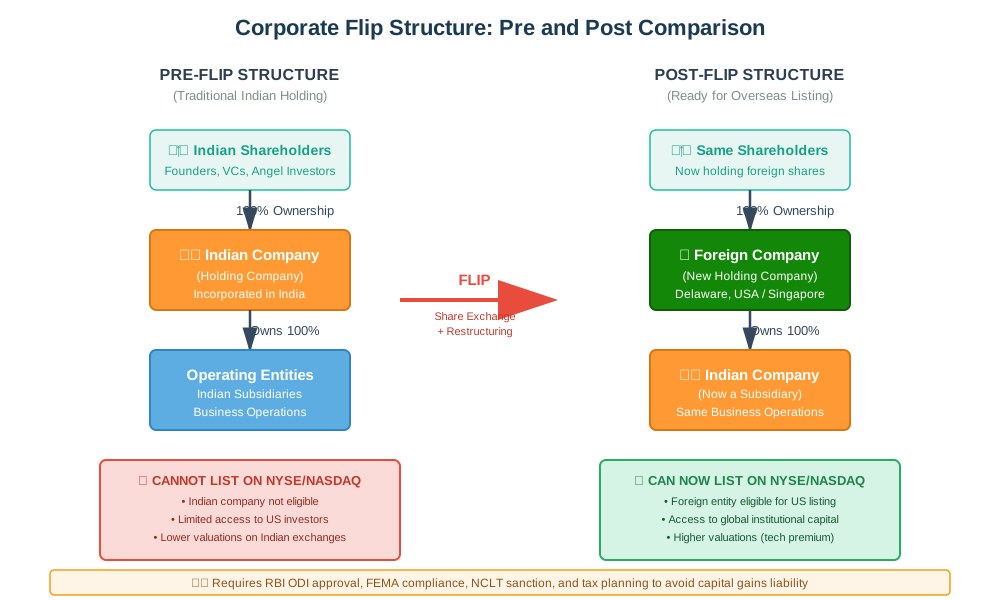
|
Pre-Flip |
Post-Flip |
| Indian Co. (Holdco) | Foreign Co. (Holdco) |
| ↓ owns | ↓ owns |
| Operating entities | Indian Co. (Subsidiary) |
| Indian shareholders | Foreign shareholders (same individuals, now holding foreign shares) |
Compliance Challenges
- Valuation Disputes: RBI has historically scrutinised valuations during flip transactions, particularly where existing shareholders receive foreign equity at a premium. Any deviation from fair market value can trigger FEMA violations.
- Round-Tripping Concerns: If Indian promoters control the overseas entity, the RBI examines whether the structure constitutes prohibited round-tripping of funds back into India.
- Sectoral Caps: Certain sectors (e.g., defense, multi-brand retail) face FDI restrictions. Flipping ownership may inadvertently breach these caps if not carefully structured.
Regulatory Framework II: SEBI’s Consultation Paper on SPACs (2024)
In March 2024, SEBI released a much-anticipated consultation paper on introducing SPACs in India. The regulator sought public comments on whether India should permit domestic SPACs and, if so, under what safeguards.
Why SEBI Has Not Approved SPACs Yet
Despite global popularity, SEBI’s hesitation stems from legitimate investor protection concerns:
- Promoter Conflicts of Interest
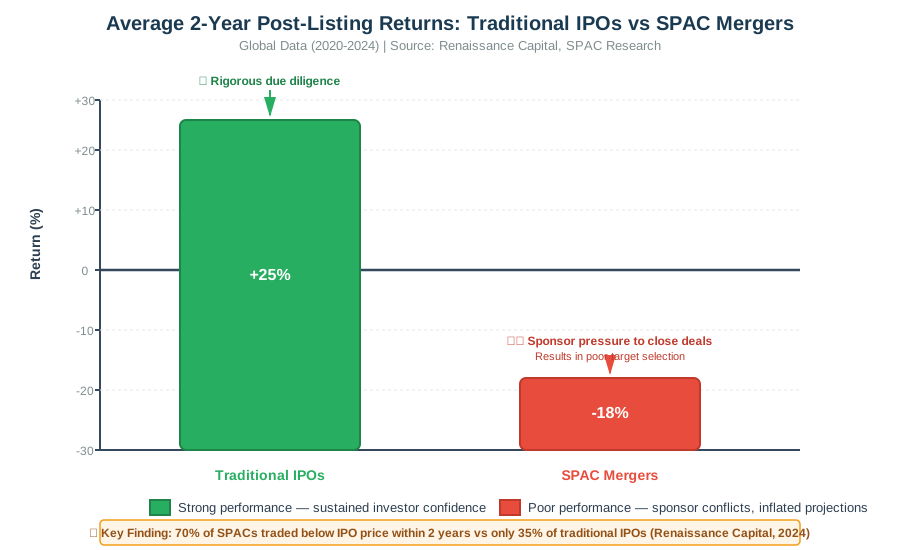
SPAC sponsors (promoters) typically receive 20% of the post-merger equity as “founder shares” at nominal cost—creating a structural incentive to complete any deal, not necessarily a good deal. This misalignment has led to poor post-merger performance globally, with studies showing SPAC-listed companies underperforming traditional IPOs by 30–50% within two years.
- Retail Investor Vulnerability
Indian markets have a large retail investor base (over 9 crore demat accounts as of 2024). Unlike sophisticated institutional investors who dominate US SPAC subscriptions, Indian retail investors may lack the expertise to evaluate “blank check” investments, increasing mis-selling risks.
- Market Manipulation Risks
The two-year timeline for SPACs to find a target creates pressure to announce deals prematurely. In several US cases, sponsors inflated projections to secure shareholder approval, leading to securities fraud investigations.
- Lack of Operational Track Record
Traditional IPOs require three years of audited financials. SPACs bypass this entirely. SEBI is concerned that allowing SPACs would undermine investor due diligence standards painstakingly built over decades.

SEBI’s Proposed Framework (Highlights from 2024 Consultation Paper)
If approved, SEBI’s framework would likely include:
- Minimum SPAC Size: ₹500 crore corpus
- Lock-In for Sponsors: 3-year lock-in on founder shares
- Retail Participation Cap: Limited to 20% of issue size
- Escrow Protection: 90% of IPO proceeds held in escrow until merger
- Redemption Rights: Investors can redeem shares if they oppose the merger
As of February 2025, SEBI has not issued final regulations. Market consensus suggests approval is unlikely before 2026, given ongoing concerns about market readiness.
Tax and Corporate Law Challenges in Reverse Mergers
Income Tax Implications
When an Indian startup “flips” and merges into a foreign SPAC, several tax issues arise:
- Capital Gains Tax on Share Swap
Indian shareholders exchanging Indian company shares for foreign SPAC shares trigger a capital gains event under Section 45 of the Income Tax Act, 1961. The tax liability depends on:
- Holding period: Long-term (>24 months) vs short-term
- Valuation: Fair market value (FMV) of foreign shares received
- Exemptions: No blanket exemption exists for SPAC mergers (unlike certain domestic mergers under Section 47)
- Transfer Pricing Scrutiny
The Indian tax authorities may examine whether the swap ratio reflects arm’s length valuation. Any undervaluation of Indian shares (benefiting foreign shareholders) can be reclassified as a “deemed gift” taxable under Section 56(2)(x).
- Withholding Tax on Overseas Remittances
If Indian shareholders redeem their SPAC shares post-merger, repatriation of proceeds may attract withholding tax unless covered by a Double Taxation Avoidance Agreement (DTAA).
Corporate Law Considerations
Section 230–232 (Companies Act, 2013) Compliance
The flip transaction often requires NCLT approval under the scheme of arrangement provisions if it involves a merger or demerger. This adds 6–9 months to the timeline and requires:
- Creditor and shareholder approvals (75% majority)
- No objection certificates from tax and regulatory authorities
- Court-sanctioned fairness opinion
Minority Shareholder Protection
NCLT closely scrutinises whether minority shareholders receive fair value in cross-border mergers. Any oppression or mismanagement allegations (Sections 241–242) can derail the transaction.
Conclusion: A Path Forward
The regulatory landscape for SPACs and overseas listings in India is at an inflection point. While startups will continue seeking global capital through existing ODI routes, SEBI’s reluctance to approve domestic SPACs reflects a mature, cautious approach to investor protection.
For Indian startups, the message is clear: overseas listings remain viable but require meticulous legal, tax, and regulatory planning. As global SPAC performance data matures and SEBI gains confidence in safeguards, India may eventually embrace this innovation—but not at the cost of retail investor welfare.
Until then, founders must weigh the benefits of speed and global visibility against the complexity, cost, and reputational risks of navigating a still-evolving cross-border regulatory maze.
References
- SEBI Consultation Paper on SPACs (March 2024)
- RBI Master Direction on Overseas Investment, 2022
- Income Tax Act, 1961 (Sections 45, 47, 56)
- Companies Act, 2013 (Sections 230–232, 241–242)
- FEMA (Overseas Investment) Rules, 2022


