
The Anatomy of Inflation: 8 Global Crises That Changed the World

“Inflation is taxation without legislation.” – Milton Friedman
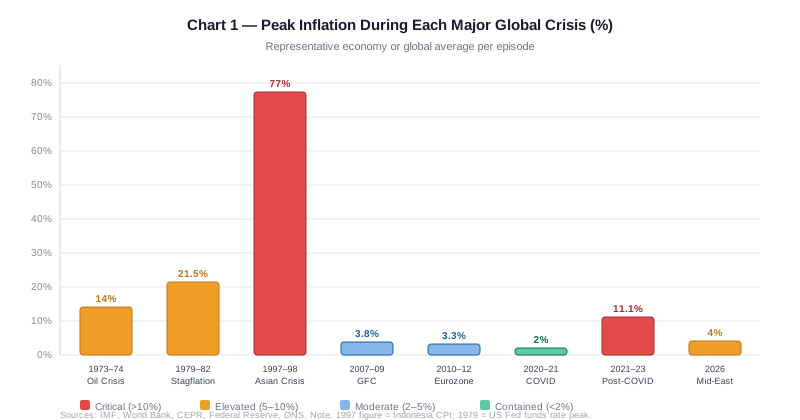 Inflation is among the most consequential and persistently misunderstood forces in global economics. It erodes purchasing power with the quiet efficiency of rust invisible in the short term, structurally devastating across decades. To understand its 2026 resurgence, one must first audit its genealogy: the crisis episodes that have punctuated the global economy since 1973, the nations they engulfed, and the industries irreversibly reshaped by their passage. What this chronicle reveals is not a series of isolated accidents but a recurring architecture supply shock, monetary excess, and geopolitical rupture, rarely occurring in isolation, always compounding in consequence.
Eight Defining Crises: Chronology, Causation, and Country Impact
The table below presents a definitive reference matrix of every major inflationary and economic crisis from the first oil shock to the present Middle East disruption, with peak inflation, GDP trajectory, and the ten nations most severely affected in each episode.
|
Year |
GDP | Root Causes | Top 10 Countries Hit |
Peak Inflation |
|
1973–74 |
−0.5% |
OPEC oil embargo; Arab-Israel War; oil prices quadrupled overnight | USA, UK, Japan, Germany, France, Netherlands, Italy, Australia, Canada, NZ | ~11–15% advanced economies |
|
1979–82 |
−0.3% |
Second oil shock; Iran Revolution; Volcker rate shock; stagflation | USA, UK, Brazil, Mexico, Argentina, Germany, Poland, Turkey, Chile, Yugoslavia | USA: 21.5%; global avg ~13% |
|
1997–98 |
2.5% |
Asian currency contagion; IMF bailouts; capital flight from EM | Thailand, S. Korea, Indonesia, Malaysia, Philippines, Japan, Russia, Hong Kong, Brazil, Argentina | Indonesia: 77%; Russia: 84% |
|
2007–09 |
−2.1% |
US subprime collapse; Lehman Brothers; global credit freeze | USA, UK, Iceland, Ireland, Spain, Greece, Latvia, Ukraine, Hungary, Dubai | Deflationary risk; USA −2.1% GDP |
| 2010–12 |
2.4% |
Eurozone sovereign debt; austerity mandates; ECB emergency measures | Greece, Italy, Spain, Portugal, Ireland, Cyprus, France, Belgium, Hungary, Romania | Greece: 3.3%; Spain: 3.1% |
|
2020–21 |
−3.1% |
COVID-19 pandemic; global lockdowns; $8.9T Fed balance sheet expansion | USA, India, Brazil, UK, France, Germany, Italy, Russia, South Africa, Argentina | Deflation 2020 → surge 2021–22 |
|
2021–23 |
3.5% |
Post-COVID demand surge; Russia–Ukraine war; supply chain rupture | USA, UK, EU-27, Turkey, Argentina, Sri Lanka, Pakistan, Ghana, Egypt, Ethiopia | USA: 9.1%; UK: 11.1%; Turkey: 85% |
|
2026 (live) |
2.5% |
Middle East conflict; Strait of Hormuz disruption; energy price spike | USA, UK, EU, India, Japan, China, Germany, S. Korea, Saudi Arabia, Turkey | G20: 4.0%; India CPI: 3.9% |
Three dynamics recur across every crisis: energy price transmission, monetary over-accommodation in the preceding recovery, and a geopolitical rupture that converts structural fragility into open crisis.
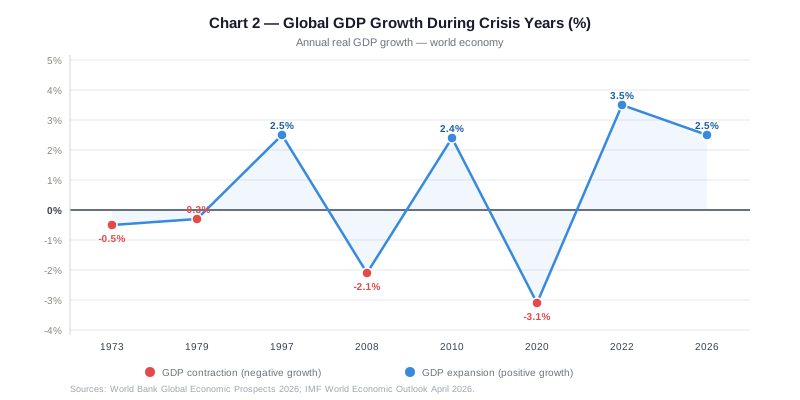 The 1973–74 oil embargo inaugurated the era of geopolitically-engineered inflation Arab OPEC members quadrupled crude prices overnight, producing the first synchronised recession across industrialised economies. The 1979–82 stagflation era delivered the most severe monetary contraction of the post-war period; Volcker’s rate hikes to 21.5 percent broke inflation but triggered Latin America’s debt collapse. The 1997–98 Asian contagion demonstrated the velocity of currency crisis in liberalised capital markets Indonesia’s inflation reached 77 percent within months of the Thai baht’s devaluation.
The 2007–09 Global Financial Crisis proved paradoxically deflationary in its immediate phase the collapse of credit demand overwhelmed supply-side price pressures but its monetary response (quantitative easing on an unprecedented scale) seeded the inflation surge that would arrive a decade later. The 2010–12 Eurozone crisis exposed the structural incoherence of monetary union without fiscal union, as austerity-mandated demand compression drove peripheral economies into prolonged recession. The 2020–21 pandemic shock produced the sharpest synchronised contraction in recorded history: GDP fell 3.1 percent globally as lockdowns paralysed productive capacity across 190 countries simultaneously.
The 2021–23 post-pandemic inflation surge was the most broad-based since the 1970s. Russia’s invasion of Ukraine in February 2022 compounded an already-strained supply system, pushing US CPI to 9.1 percent and UK inflation to 11.1 percent — levels unseen in four decades. The current 2026 episode, driven by Middle East conflict disrupting Strait of Hormuz oil flows, has elevated G20 inflation to 4.0 percent and slowed global GDP to 2.5 percent (World Bank), halting the disinflation trajectory that had been underway since mid-2023.
Ten Industries Most Devastated Global and India Impact
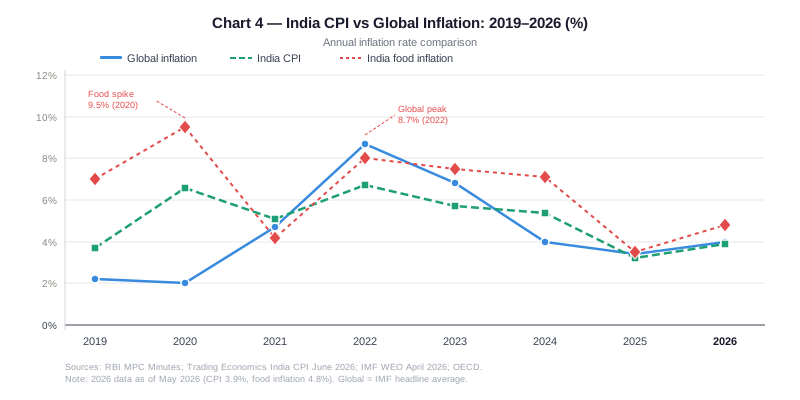 Inflation distributes its burden with structural precision certain industries, by virtue of energy intensity, capital requirements, or consumer discretion exposure, bear disproportionate damage in every episode. The matrix below identifies the ten most consistently affected sectors globally, with India-specific transmission analysis.
|
Industry |
Global Impact |
India Impact |
| Energy & Petroleum | Epicenter of every crisis since 1973. Supply shocks transmit directly to all input costs globally. | 87% crude import dependency $10/bbl rise widens trade deficit by ~$15B. |
| Banking & Finance | Credit freezes (2008), sovereign contagion (2012), capital flight (1997) strike balance sheets first. | NPAs rise, RBI tightens, SME credit contracts, home loan rates climb. |
| Agriculture & Food | Fertiliser costs, logistics collapse, climate shocks rupture food supply chains in every episode. | Food = 46% of India’s CPI basket every global food shock hits rural and urban India directly. |
| Manufacturing & Auto | Demand collapse in recessions; input cost inflation in supply shocks worst when both coexist. | Input inflation cut margins; 2020 and 2022 slowdowns devastated Tier-2 auto ancillary suppliers. |
| Real Estate | Rate hikes to suppress inflation kill mortgage demand and freeze construction pipelines globally. | RBI hikes in 2022–23 slowed housing starts; metro affordability gap widened materially. |
| Retail & FMCG | Inflation erodes purchasing power; consumers trade down; volume contraction across discretionary goods. | Major FMCG companies reported volume decline of 4–8% in 2022–23 amid double-digit input inflation. |
| Technology | Chip shortage (2020–22); AI capex inflation (2026) semiconductor scarcity drives cost cascades. | IT export revenues benefit from rupee weakness; but energy-intensive AI infra adds to domestic inflation. |
| Aviation & Tourism | Jet fuel (~25–30% of airline operating costs) spikes with every oil shock, forcing fare hikes or losses. | Indian carriers revised fares upward in 2022 and 2026; narrow-margin low-cost model severely stressed. |
| Healthcare & Pharma | API import inflation, packaging cost surge, and reduced public health budgets in austerity cycles. | India — world’s pharmacy — faces structural vulnerability from China-sourced API price volatility. |
| Logistics & Supply Chain | Shipping rate spikes (Baltic Dry Index), fuel surcharges, and port congestion cascade across all sectors. | Freight inflation in 2021–22 raised landed import costs and squeezed export competitiveness. |
India’s Structural Exposure and Policy Response
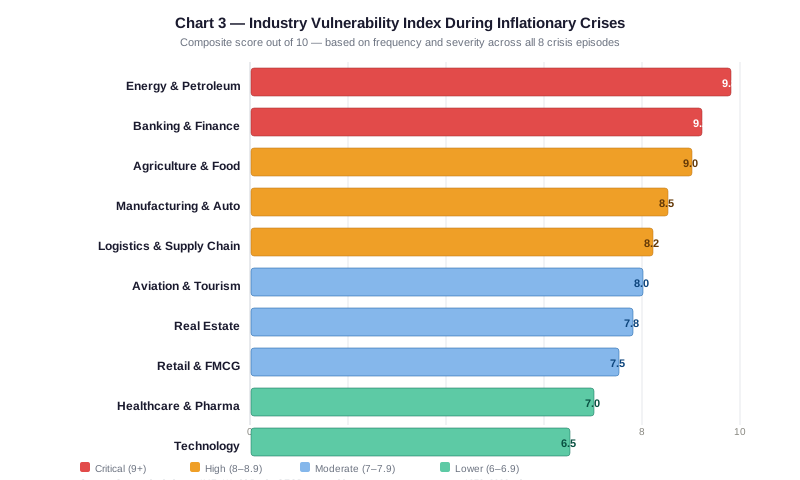 India enters the 2026 stress cycle with considerably stronger macro-fundamentals than previous episodes foreign exchange reserves covering eleven months of imports, merchandise exports crossing $500 billion in FY26, and a digital financial infrastructure insulating domestic consumption from some external shocks. India’s CPI stood at 3.9 percent in May 2026, below the RBI’s medium-term target of 4 percent, yet with food inflation already at 4.8 percent the highest in sixteen months.
Three structural vulnerabilities remain unresolved. First, 87 percent crude oil import dependence renders India’s current account directly hostage to Strait of Hormuz dynamics. Second, food inflation’s structural drivers fertiliser import dependency, monsoon variability, and El Niño risks cannot be addressed by monetary policy alone. Third, rupee depreciation (averaging ₹92.58/USD) transmits global energy costs into domestic prices at a rate that the RBI can moderate but not neutralise. The MPC’s decision to hold the repo rate at 5.25 percent in April 2026 explicitly acknowledging that a supply-driven shock does not warrant demand destruction reflects a sophisticated, evidence-based policy posture. The central challenge for the months ahead is maintaining GDP growth at 6.9 percent while ensuring that energy and food-led price pressures do not entrench inflationary expectations in the broader economy.
Conclusion
The fifty-three-year chronicle examined herein establishes an incontrovertible pattern: inflationary crises are endogenous products of accumulated structural fragility, not exogenous accidents. Every episode from 1973 to 2026 was preceded by a period of monetary excess, geopolitical complacency, or supply-chain under-investment. The nations and industries that weather these storms with least damage are invariably those that invested in structural diversification before the crisis arrived. For the informed reader, investor, or policymaker, the operative lesson is not prediction – it is preparation.
Sources: IMF WEO April 2026 • World Bank Global Economic Prospects 2026 • OECD Interim Report March 2026
UN WESP Mid-2026 • RBI MPC Minutes April 2026 • CEPR • Trading Economics India CPI June 2026


