
Agentic AI in Financial Services: The Next Frontier of Fintech Innovation

The financial services industry stands at the precipice of a transformative technological revolution. Agentic artificial intelligence represents a paradigm shift from passive computational tools to autonomous, intelligent systems capable of independent decision-making, multi-step planning, and adaptive learning. Unlike traditional automation or even generative AI, agentic AI possesses the unprecedented ability to perceive complex environments, formulate strategic responses, and execute actions without constant human intervention.
This evolution fundamentally redefines how financial institutions operate, moving from rule-based processes to intelligent, context-aware systems that can navigate the intricate landscape of modern finance with remarkable sophistication. As financial markets become increasingly complex and data-driven, agentic AI emerges not merely as an enhancement but as an essential infrastructure for competitive advantage in the digital economy.
Understanding Agentic AI: Beyond Traditional Automation
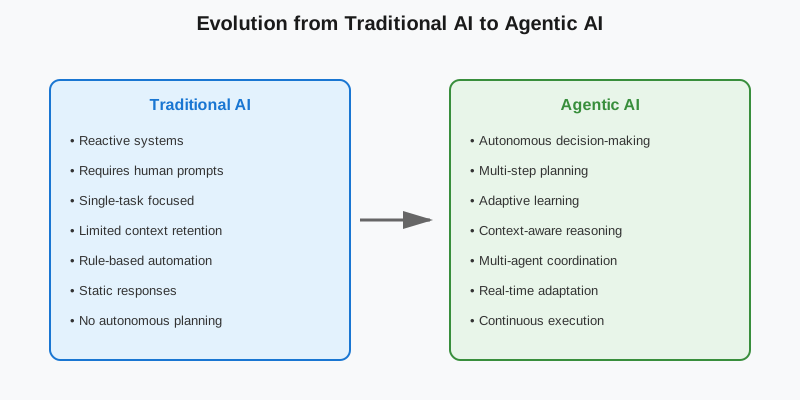
Agentic AI differs fundamentally from conventional artificial intelligence systems in its capacity for autonomous agency. Traditional AI operates reactively, responding to specific prompts and executing predefined instructions within narrow parameters. These systems excel at pattern recognition and data processing but lack the cognitive architecture necessary for independent strategic thinking.
In contrast, agentic AI systems integrate advanced large language models, reinforcement learning algorithms, and multi-agent frameworks to achieve genuine autonomy. These systems can decompose complex objectives into actionable subtasks, dynamically adjust strategies based on real-time feedback, and coordinate with other AI agents to accomplish sophisticated goals that would traditionally require extensive human oversight.
The architectural foundation of agentic AI encompasses three critical capabilities: perception, which enables systems to continuously monitor and interpret environmental data; reasoning, which allows for strategic planning and decision optimisation; and action, which facilitates autonomous execution of multi-step workflows. This tripartite structure enables agentic AI to function as a collaborative intelligence rather than a passive tool, fundamentally transforming the human-machine relationship in financial services.
Strategic Applications Across Financial Operations
Financial institutions are deploying agentic AI across diverse operational domains, each demonstrating substantial improvements in efficiency and decision quality. In portfolio management, AI agents autonomously monitor global markets, identify non-obvious correlations between asset classes, and dynamically rebalance allocations in response to emerging opportunities and risks. This continuous optimisation occurs at scales and speeds impossible for human analysts, enabling institutions to capitalise on fleeting market inefficiencies.
Credit risk assessment has been revolutionised through agentic systems that continuously evaluate borrower solvency using real-time data streams, adapting underwriting models to reflect current economic conditions rather than historical patterns. In fraud detection, multi-agent systems collaborate to identify sophisticated attack vectors, learning from attempted breaches to strengthen defensive protocols without manual recalibration.
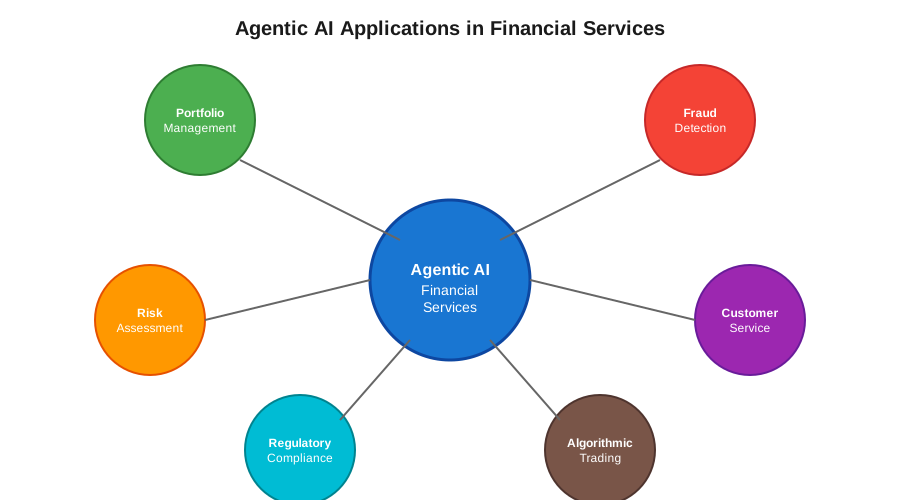
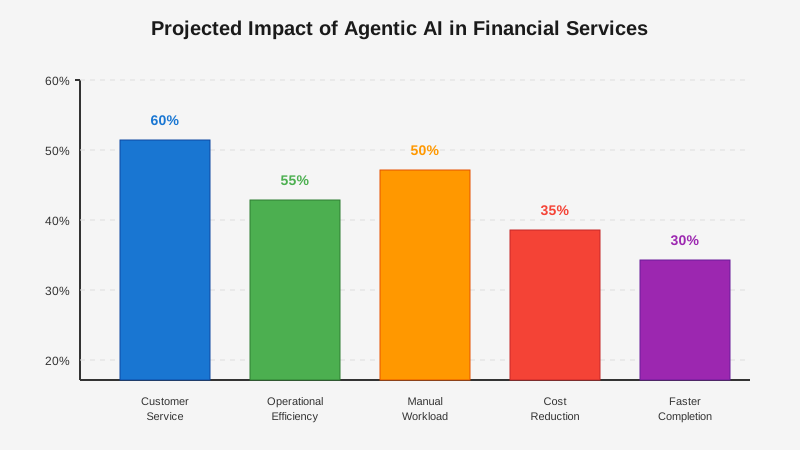
Customer service operations have witnessed transformative improvements, with adoption rates rising from twenty-five per cent to sixty per cent within a single year. Agentic customer service systems provide personalised financial guidance, identify cross-selling opportunities, and resolve complex inquiries through natural language interaction, significantly reducing response times while improving customer satisfaction metrics.
Quantifiable Impact and Performance Metrics
Empirical evidence demonstrates substantial returns on agentic AI investments across the financial sector. Organisations implementing these systems report operational efficiency improvements exceeding fifty-five percent, while manual workload reductions approach fifty percent in high-volume processing environments. Cost reductions average thirty-five per cent, driven primarily by automation of repetitive tasks and reduction in error-related remediation expenses.
|
Impact Category |
Improvement Range |
Primary Drivers |
| Operational Efficiency | 50-55% | Process automation and optimisation |
| Manual Workload Reduction | 30-50% | Autonomous task execution |
| Cost Reduction | 25-35% | Labor optimization and error reduction |
| Task Completion Speed | 30% faster | Real-time processing capabilities |
| Customer Service Adoption | 60% (from 25%) | Enhanced user experience and availability |
Research indicates that organisations investing in agentic AI achieve returns averaging three dollars and fifty cents for every dollar invested, with high-performing institutions realising returns approaching eight dollars per dollar invested. These metrics underscore the technology’s capacity to generate substantial value through enhanced decision quality and operational leverage.
Governance Frameworks and Risk Management
The autonomous nature of agentic AI necessitates robust governance frameworks to ensure regulatory compliance, mitigate bias, and maintain auditability. Financial institutions operate within stringent regulatory environments where accountability and transparency are paramount. Effective governance requires comprehensive data curation practices, structured decision-tracking mechanisms, and human oversight protocols that balance automation with accountability.
Organisations must implement transparent audit trails that enable financial professionals to interrogate AI-generated recommendations and verify decision logic. This becomes particularly critical in credit decisioning, where regulatory requirements mandate explainability and fairness. Additionally, institutions must address emerging risks, including deepfake-enabled fraud, which has surged over two thousand percent in recent years, and privacy vulnerabilities associated with AI systems accessing sensitive consumer data.
Conclusion: The Path Forward
Agentic AI represents an inflection point in financial services technology, offering unprecedented capabilities for autonomous decision-making and operational optimisation. As industry forecasts project that forty percent of enterprise applications will integrate task-specific AI agents by the end of 2026, financial institutions face strategic imperatives to develop robust implementation frameworks.
Success requires more than technological adoption; it demands comprehensive organisational transformation encompassing data infrastructure modernisation, workforce skill development, and governance framework evolution. Institutions that strategically navigate this transition, balancing innovation with prudent risk management, will establish competitive advantages in an increasingly AI-driven financial ecosystem. The question facing financial leaders is not whether to adopt agentic AI, but how to implement it most effectively to maximise value creation while maintaining the trust and stability essential to financial services.


